Part 1 established that the model is stateless. Part 2 established that its memory is finite and expensive. Put those together and an awkward question falls out: if the model remembers nothing and can only be handed so much at once, who decides what it gets to see? The answer is the layer you thought was just a chat window. The Layer That Holds Everything the Model Can’t # Open WebUI is a web application. Svelte in the browser, a Python backend, a database on disk. There is no model inside it and no inference happening in it. If Ollama is switched off, Open WebUI still loads perfectly — it simply has nothing to talk to.
Introduction # HTTP response headers provide additional information about the server’s response to an HTTP request. These headers are essential for web developers and server administrators to ensure efficient and secure communication between clients and servers. In this blog post, we will discuss some of the most common HTTP response headers and provide example values for each header.
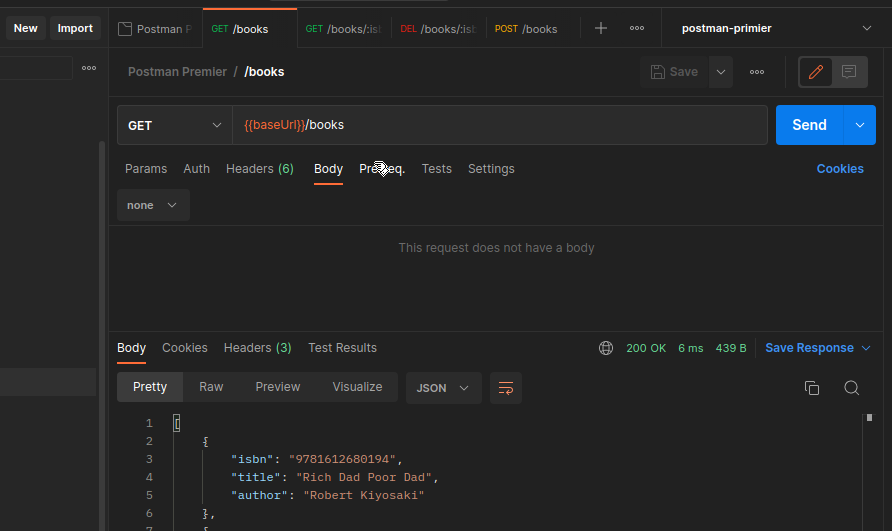
Introduction # In Postman Premier - The Minimal Postman you need to Learn, I posted the minimum of Postman you need to learn. In this article, I’m going to expand on that knowledge and dig more into the response. In this post, I’ll be asserting the response on certain values and response codes and more.
What are assertions and how to use it # Assertions are nothing but test cases we give to a particular request. In the previous post, we already have seen that each of the requests has a Tests tab. There we write code in JavaScript, judging specific parameters of the response.
Introduction # Welcome to my Fullstack with Santosh. Today we are going to learn about how to use Postman as a backend engineer to make our daily life easier. Postman is an API testing tool where you can test your REST APIs. It has now developed into handling many different kinds of interfaces, but today we are going to focus on the REST APIs.
Introduction # Unlike FastAPI, Gin does not have OpenAPI integration built in. With FastAPI when you add a route, documentation is already generated. With Gin, this is not the case. But recently I integrated Swagger UI in one of my Go backends and I wanted to document that process.
Prerequisites # An already existing Gin server You might consider Building a Book Store API in Golang With Gin if you are starting from scratch. I’ll be using the same book store and extending over it to integrate Swagger UI.
Introduction # Go community believes that we need no framework to develop web services. And I agree with that. When you work without using any framework, you learn the ins and outs of development. But once you learn how things work, you must reside in a community and don’t reinvent the wheel.
I have created POCs in Go before and I had to deal with HTTP headers, serializing/deserializing, error handling, database connections, and whatnot. But now I’ve decided to join the Gin community as it is one of the widely accepted in the software development community.
Introduction # The way we used to deliver resources to the client in a server-client setup is now drifting away from REST to a more modern delivery mechanism. Two of them are gRPC and GraphQL. While both these solve a different kind of problem, REST is going to stay for a while. It is the simplest to learn at least.
Introduction # Send a POST request in golang is pretty daunting if you have a post body and you’re coming from a scripting language like JavaScript or Python. Here in Go, schema for JSON needs to be defined beforehand in order to marshal and unmarshal string back and forth to JSON.
Simple POST # This marshaling/unmarshalling could be an oneliner if your request body is not nested, or is one level deep, or there is not even a body. Consider this example: