Introduction # Testify is a popular testing toolkit for the Go programming language. It provides a wide range of assertion functions, test suite support, and mocking capabilities, making it a powerful tool for testing Go applications. Testify aims to simplify the process of writing tests and improve the quality of test coverage in Go applications.
Testing is a critical aspect of software development that helps ensure that the software behaves as intended and catches bugs early in the development process. Writing tests can be time-consuming, but it is essential for delivering a reliable and maintainable software system. Testify can help make testing in Go more efficient and effective.
Introduction # In Postman Premier - The Minimal Postman you need to Learn, I posted the minimum of Postman you need to learn. In this article, I’m going to expand on that knowledge and dig more into the response. In this post, I’ll be asserting the response on certain values and response codes and more.
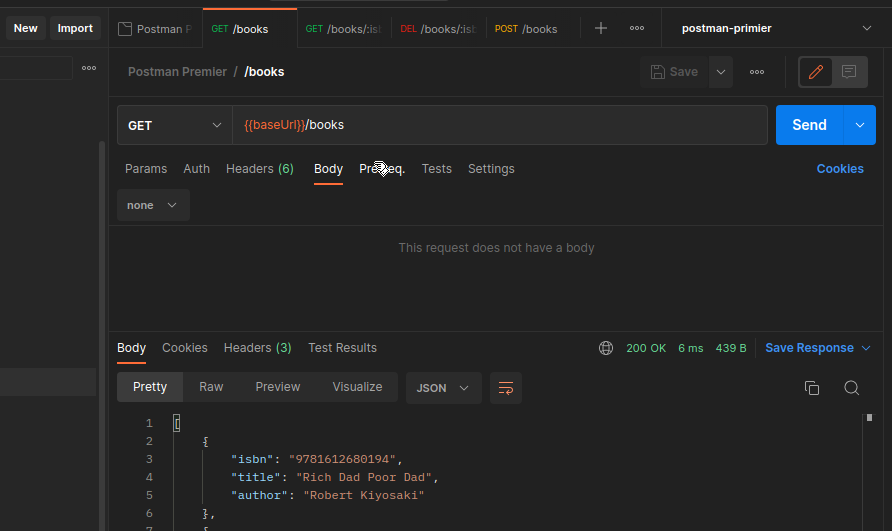
What are assertions and how to use it # Assertions are nothing but test cases we give to a particular request. In the previous post, we already have seen that each of the requests has a Tests tab. There we write code in JavaScript, judging specific parameters of the response.
Introduction # Welcome to my Fullstack with Santosh. Today we are going to learn about how to use Postman as a backend engineer to make our daily life easier. Postman is an API testing tool where you can test your REST APIs. It has now developed into handling many different kinds of interfaces, but today we are going to focus on the REST APIs.
Introduction # There are a few words, like unit testing, integration testing, mocking, dependency injection, object oriented proramming. These are all friends, and areall related to each other. In this post I’m going to talk how, and then it will start to make sense to you.
This post is divided into these subsections:
Preamble The Testing part The OOPs part The dependency injection part A real life problem I’ll start with how I started with unit testing.
Introduction # Like most self-taught programmers, I spent a lot of my years dabbling with different technologies. But there comes a time in every programmer’s life when they have to learn data structures and algorithms to proceed in their careers. In this post, I will go through the basics of data structures, what purpose they serve, and what’s common between all of them.
Introduction # From The Zen of Go:
If you think it’s slow, first prove it with a benchmark
Don’t assume if things are slow. Benchmark it and see if they are really slow.
One thing to note here is benchmarking a program is different from profiling a program.
Benchmarking is the way we check how fast our algorithm is for a given unit of the program. In benchmarking, we typically see how many iterations can a piece of code can run in a given time.
You can’t think of deploying your application to production without testing it.
Neither you can manage a large codebase with confidence without it.
Let us go through some basics of unit testing in golang.
This post is structured in the following manner:
unit testing basics in golang (jump) inbuilt code coverage command understanding subtests and helper function (jump) Travis CI integration (jump) running test against multiple version of go Please connect with me on LinkedIn and let’s get started.
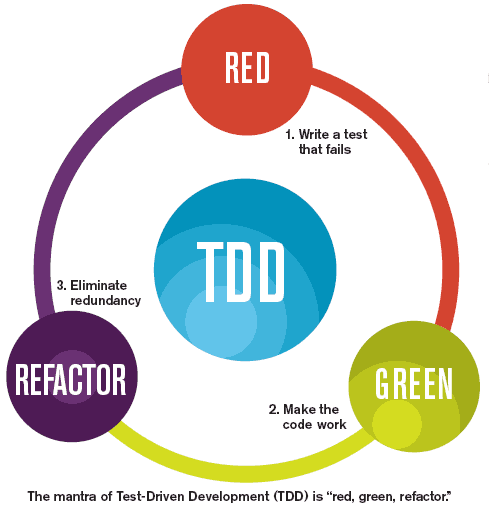
In this post, I’ll show a glimpse of software testing and how test-driven development works in a nutshell.
Why Do We Test # Every little software grows big, trying to solve more problem regarding its particular domain. It faces bugs in the way which also needs to be taken care of.
As software grows big. It becomes harder to go and test if every part of the software is behaving the way it should. Take the example of a Django application. If the manual path is taken, one is supposed to test every layer of the application, including Model and Views against each if and else in the control flow.