Introduction # I have seen many people coming from Python background struggling with Go. What I have obeserved it they write code that is limited to writing functions and calling them. They never leverage design constructs such as abstraction, encapsulation, inheritance, composition etc. I can understand their pain because I’ve been in the same boat.
In today’s post I’ll compare how we write classes in Python vs how we do the same thing in a Go way.
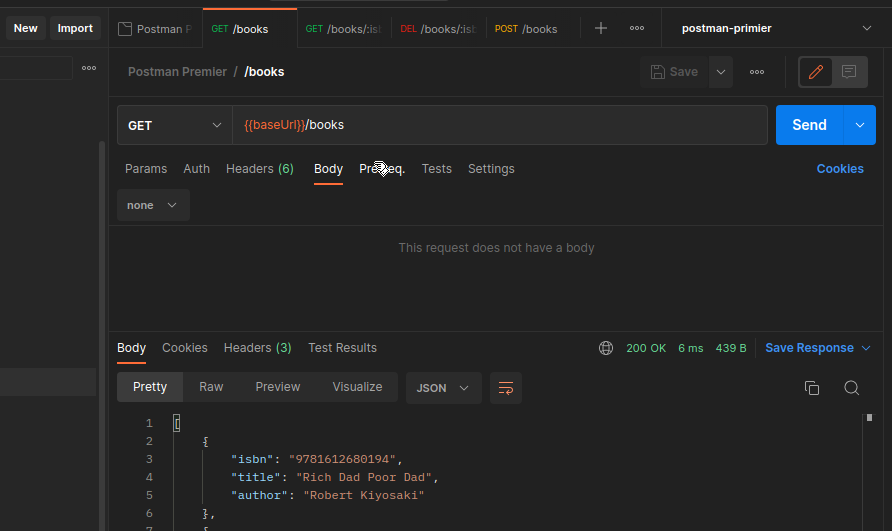
Introduction # In Postman Premier - The Minimal Postman you need to Learn, I posted the minimum of Postman you need to learn. In this article, I’m going to expand on that knowledge and dig more into the response. In this post, I’ll be asserting the response on certain values and response codes and more.
What are assertions and how to use it # Assertions are nothing but test cases we give to a particular request. In the previous post, we already have seen that each of the requests has a Tests tab. There we write code in JavaScript, judging specific parameters of the response.
Introduction # Welcome to my Fullstack with Santosh. Today we are going to learn about how to use Postman as a backend engineer to make our daily life easier. Postman is an API testing tool where you can test your REST APIs. It has now developed into handling many different kinds of interfaces, but today we are going to focus on the REST APIs.
Introduction # Database normalization is the process of structuring a database, in accordance with a series of normal forms in order to reduce data redundancy and improve integrity.
In other words, database normalization is basically breaking a table into two to prevent repetitive columns aka data redundancy. It entails organizing the columns (attributes) and tables (relations) of a database to ensure that their dependencies are properly enforced by database integrity constraints. It is accomplished by applying some formal rules either by a process of synthesis (creating a new database design) or decomposition (improving an existing database design).
Introduction # I recently conducted a poll in the Go community regarding which logging library they use in their personal or professional project. The results were interesting. In this post I have jotted down the most favorite logging libraries and here is my opinion about them.
Poll Results # Here are the poll results which I conducted on r/golang, The Go Programming Language community on Twitter and my LinkedIn following.
Introduction # Today we are going to do a hands-on on how to kill a dangling EIP or in other words, deallocate an unassigned Elastic IP. But before that, let us know…
What is an Elastic IP and why do we need it? # Elastic IPs are simply IP addresses provided by Amazon AWS. These are usually attached to internet gateways such as load balancers, or even EC2 instances. I have been using it with EC2 instances directly for my testing use case.
Introduction # In the last post, we have already seen that we can classify entire data structure into linear and non-linear data structure. Today we will see how we can implement one of the linear data structures in Java.
Initial plan was to implement Linked List in Python. But Python is so higher level that we’d be actually writing higher order data structure on top of high order data structure. What I try to say with that is Python already has those data structure implemented. Java is more close to C/C++, and gives a balance of features and flexibility. I’d have chosen C++ for this post, but I don’t want to deal with memory management and pointers for sake of this post.
Introduction # We have previously seen how you can Spin up your own VPN on Ubuntu 20.04. Among many benefits, one of the benefits of the VPN is geographical anonymity.
Today we are going to discuss and set up yet another benefit. We are going to tweak our VPN server set up a little bit to enable ad-blocker out of the box. Meaning that you won’t have to install an ad-blocker on your browser. It will be enabled connection-wide. You won’t be seeing any ads on devices that you can’t control ads on, like smart TV, etc.
Introduction # Unlike FastAPI, Gin does not have OpenAPI integration built in. With FastAPI when you add a route, documentation is already generated. With Gin, this is not the case. But recently I integrated Swagger UI in one of my Go backends and I wanted to document that process.
Prerequisites # An already existing Gin server You might consider Building a Book Store API in Golang With Gin if you are starting from scratch. I’ll be using the same book store and extending over it to integrate Swagger UI.
Introduction # In last post we learned to install and configure Portainer to maintain your local Docker environment. Although I’m not against command line, Portainer is a great companion if you don’t prefer to remember long commands to manager your docker. In this post I’m going to extend on last post and show how can you manage your VPS docker environment from your local Portainer installation.
Introduction # This is a quick post where I demonstrate how to install Portainer on Ubuntu. Regardless this tutorial is demonstrated on Ubuntu, you can run Portainer on whatever Docker host you are using including Windows.
Most awaited Docker Desktop is available for Linux now. Still, it is a desktop application. There is also an alternative that you already might have heard of if you have worked with Kubernetes. It is called Portainer.
Introduction # The Internet has evolved in the last 2 decades a lot. HTTP/1.1 was not enough so we have HTTP2 now. The specification we used to transfer data between the client and the server has also evolved. From XML to JSON, now we have Protocol Buffer, which is a binary spec. Let’s dive deeper.
The picture below from Wikipedia shows how exponential data is growing.
Introduction # We have been using FastAPI along with the Test-Driven Development process to come up with an authentication system. Till now we can register to own tiny application using a username and password. We are also able to generate a JWT token to be classified as a logged-in user. But there is no point in logging in until the logged-in user can do something privileged. In this iteration of the series, we’d see how to access a protected endpoint using FastAPI and JWT. Given that we already have a JWT token.